Simple Survival recipe for a 27 below zero morning in Hovland, Minnesota
kitchen experiment after a Saturday night family dinner of barbecue ribs (using an August bought bbq so. ill. sauce I carried north with me), mashed red potatoes, & baked beans; my oldest brother said this is one of the best loaves of bread he has ever tasted, so here are the approximate measurements:
2 c. 85 degree potato water (let cool after straining from boiled potatoes)
1 heaping teaspoon dry active yeast
1 tsp maple syrup
Mix and let stand 10 minutes for yeast to activate.
5 c. white flour
1 tbsp. dry rubbed sage (rub in hands before adding to let aromatic oils release in the kitchen space.
1 tsp fennel seed
2.5 tsp salt
Mix, then add wet yeast mixture; knead 5-10 minutes. Cover, listen to Ave Maria and let rise about 1.5 hours, then form loaves and let rise as oven preheats. Bake at 350 degrees for 55 minutes. Slice, toast, lather with butter and peach preserves as I dream about summer and loathe myself for participating in this post-post colonial hell called bittersweet north pole shift in this magical place I call home and this bodily temple I think of as Eire now.
Sunday, January 5, 2014
Thursday, June 6, 2013
Pineapple Weed: American Chamomile
Pineapple weed (Matricaria matricariodes)
Pineapple weed is the first medicinal herb I learned in the
wild country of northern Minnesota. Like plantain, it grows in an incredibly
broad climate range. A close American relative of European chamomile
(Matricaria recutita), pineapple weed shares many of the same medicinal qualities:
a soothing nervine, calming digestive tonic. It commonly grows in driveways and
gravelly areas, so it is especially important to avoid harvesting flowerheads
from high traffic areas. Also, only harvest summer flower heads as they are more flavorful and better medicine. Pineapple weed makes a yummy tincture, or can be dried
and taken as tea.
Friday, May 31, 2013
Making the Most of Invasives: Albizia (Mimosa tree) Medicine
Here is an article I wrote last summer on mimosa flower medicine, after visiting Mountain Gardens in North Carolina, a 40 year running land project in the Blue Ridge Mountains focusing on growing native Appalaichan and Chinese medicinal herbs. I'm posting it now since it will soon be time to harvest albizia flowers, which are another delicious and powerful flower medicine. Albizia is another example of an invasive plant whose spread needs to be controlled; and whose use in Traditional Chinese Medicine only strengthens the case for its harvest.
Yesterday morning, I climbed up the step stool and grasped a
mimosa branch, reaching for as many aromatic pink flowers as I could find. The
bees and other insects were hovering over the flora; a noteworthy sign that the
time is right to harvest. This indicates the essential oils and vitality of the
flowers are at their peak.
The mimosa
tree, Albizia julibrissin, is generally considered a pernicious weed throughout
the South; it is indeed a non-native plant that quickly spreads throughout the
eco-system. However, albizia is also an important herb for happiness in Chinese
medicine; both the flowers and bark can be made into a tincture. Joe Hollis, an
herbalist from Mountain Gardens in North Carolina, recently told me that
albizia is especially effective for those going through depression or
heartbreak. The herbal supplement company Planetary
Herbals concurs, noting that in Chinese medicine, “Albizia was traditionally
used to ‘calm the spirit’ and relieve emotional constraint when associated with
bad temper, bad mood, sadness, occasional sleeplessness, irritability and poor
memory. It was believed to be especially useful for anyone experiencing
profound heart-breaking loss” (see further http://www.planetaryherbals.com
/products/GP1867/). There are also scientific studies now that verify the
calming components of albizia bark.
In light of the ever-increasing interest in
herbal medicine in the U.S. along with the unstable economy, it seems wise to
me that we focus on cultivating both Eastern and Western herbs domestically. It
is also fascinating that some of the same invasive plants that are causing
serious problems in the ecosystem here (honeysuckle, kudzu, and albizia, e.g.)
could be harvested and used for medicine while simultaneously helping relieve
their footprint over other native plant life.
There
are certainly many people who are already doing this. The Chinese Medicinal
Herb Farm in Sonoma County, California organically grows over 35 Chinese herbs
for the marketplace. Joe Hollis, whom I mentioned above, orchestrates a forty
year-old project called Mountain Gardens, a botanical garden with the largest
number of Chinese herbs in the eastern U.S., grown alongside native Appalachian
herbs. I had the opportunity to visit the “paradise garden” while attending the
2012 Medicines of the Earth Symposium in Black Mountain, NC last weekend. In
one of the lectures I attended, American Herbalist Guild founder Michael Tierra
mentioned several times the imperative need for the U.S. to domestically
produce Chinese herbs. Importing them is already becoming difficult due to
factors such as rising fuel costs and the presence of heavy metals in herbs
sourced from China. In the past year here at the co-op, we have had difficulty
getting several of our Chinese herbal formulas.
There
is some concern that growing Chinese herbs outside of their native environment
will not yield the same herbs, suitable for medicinal use. There is contemporary
research that disproves this, though. Also, the climates found in China and
U.S. are very similar. After studying Dan Shen, or red sage, grown in China and
the U.S., Bill Schoenbart recently concluded that:
Dan Shen (Salvia
miltiorrhiza) can be successfully grown outside of China
with organic agricultural methods…This has positive
implications for the environment, both in
the reduction of pesticide and synthetic fertilizer
usage, and in reducing pressure on
Chinese agricultural land
due to increased demand for Chinese herbs worldwide.
So,
there are several (if not many) substantial benefits to the domestic
cultivation and wildcrafting of Chinese medicinal herbs both for individuals
and the market. I find this topic so invigorating and hopeful because it contributes
toward a full circle of sustainability: benefiting the native ecosystem in
reducing invasive plant species, using that same plant material medicinally;
while also reducing the heavy U.S. footprint on Chinese land and fossil fuel
use. That thought alone calms my spirit.
Above photos taken by Meade Aronson
Notes/further reading:
Chinese Medicinal Herb Farm: http://www.chinesemedicinalherbfarm.com/
Joe Hollis’ Mountain Gardens:
http://mountaingardensherbs.com/
Michael Tierra and philosophy of
Planetary Herbology. http://www.planetherbs.com/
Miller, James H. Nonnative Invasive Plants of Southern
Forests, 2007.
Safe, sustainable ways to
harvest herbs from the wild as described by 7song, director of the Northeast
School of Botanical Medicine. “Wildcrafting for the Practicing Herbalist”
(http://7song.com/files/Wildcrafting%20for%20the%20Practicing %20Herbalist.pdf).
Schoenbart,
Bill, L.Ac. “High Performance Thin Layer Chromatographic (HPTLC) Analysis of
Dan Shen (Salvia miltiorrhiza) Roots Grown in Different Regions of
the World” p.1)
Divine Floral Vine of Summertime: Honeysuckle
I love the sweet smell of honeysuckle that floods the air this time of year. It's so calming and uplifting to wake up and have my first conscious breath be of honeysuckle hanging on the breeze. The days here in southern Illinois are slowly turning hot and humid, and as summer hems in, that scent of cooling honeysuckle flowers is a reminder of their powerful medicine.
Known as Jin Yin Hua in Chinese medicine, honeysuckle is an energetically cooling herb traditionally used to soothe acute, inflammatory (heat) conditions such as boils and carbuncles on the skin, urinary tract infections, respiratory infections with yellow phlegm, to name a few.
It has potential for use in numerous types of culinary and medicinal recipes. I love blurring the lines between food and medicine...
Honeysuckle infused tequila:
Cover opened flowers with 100% agave tequila in covered glass jar. Let infuse at least two weeks, then strain. Makes an excellent sipping tequila or as a base to summer cocktails.
Honeysuckle tincture:
Unopened flower buds
Vodka or other grain alcohol
Glass Jar w/ lid
Harvest unopened flower buds and place in glass jar. Pour vodka over flowers, cover, and let steep at least one month, shaking jar each day. Strain, then store in glass jar out of sunlight.
Honeysuckle infused oil
Honeysuckle Rose Jelly
(Note that in no way by including this link I am endorsing Biblical womanhood, I just think this recipe looks fabulous)
Honeysuckle throat and cough syrup
Tuesday, April 23, 2013
Making violet syrup
Ingredients:
Water
Violet Flowers
Honey/sugar
Lemon juice (optional)
Pour 3 oz. boiling water over 2 oz. of the flowers; let infuse overnight in a covered container.
Strain, then add half the infusion's volume of honey or sugar; cook on low till sugar dissolves. Do not boil; this helps the syrup retain color and medicinal value. I added the juice of half an organic lemon, which seemed to enhance the flavor well. I would say if you are looking to use this for primarily culinary purposes, it might be recommendable to use sugar, as the sugar won't alter the floral flavor as much as the honey. Medicinally, though, honey would more effectively complement the violet's soothing effect on sore throat/bronchitis. For more on the historical and medicinal applications of violet, see this Sweet Violets article on Mother Earth News
It's delicious! Piquant, primaveral, purple! I plan to cover, refrigerate (like most syrups, it should last at least 3 months in the refrigerator) and experiment! Violet cocktails in August sound divine...
Wednesday, April 3, 2013
Kava Kava toxicity issue
While working in the herb aisle today at the co-op, I had a customer ask about the nerve-racking warning label of potential liver toxicity on a bottle of kava kava capsules. This is a common question, and I thought I'd link to the following Herbal Gram article that thoroughly outlines the issue. Herbal Gram is the peer reviewed journal of the American Botanical Council.
After a comprehensive, historical examination of toxicity case reports and existing research, the article points out that there is little evidence to support a direct causation between kava kava and toxicity of the liver, especially when taken within the recommended dose, and not continually. Kava is contraindicated with some pharmaceuticals, namely benzodiazepines. Kava has a long history of traditional use in the South Pacific. Read on:
"Kava safety questioned due to case reports of liver toxicity"
by Mark Blumenthal
HerbalGram. 2002; 55:26-32 American Botanical Council
To read, please visit: http://cms.herbalgram.org/herbalgram/issue55/article2147.html
Piper methysticum (kava)
NPS Photo by Bryan Harry, see http://www.botany.hawaii.edu/basch/uhnpscesu/htms/haleplnt/fish_pops/piperaceae/plant02.htm
After a comprehensive, historical examination of toxicity case reports and existing research, the article points out that there is little evidence to support a direct causation between kava kava and toxicity of the liver, especially when taken within the recommended dose, and not continually. Kava is contraindicated with some pharmaceuticals, namely benzodiazepines. Kava has a long history of traditional use in the South Pacific. Read on:
"Kava safety questioned due to case reports of liver toxicity"
by Mark Blumenthal
HerbalGram. 2002; 55:26-32 American Botanical Council
To read, please visit: http://cms.herbalgram.org/herbalgram/issue55/article2147.html
Piper methysticum (kava)
NPS Photo by Bryan Harry, see http://www.botany.hawaii.edu/basch/uhnpscesu/htms/haleplnt/fish_pops/piperaceae/plant02.htm
Monday, March 18, 2013
A (melancholic) hopeful ode to spring
The force that through the green fuse drives the flower
by Dylan Thomas
The force that through the green fuse drives the flower
Drives my green age; that blasts the roots of trees
Is my destroyer.
And I am dumb to tell the crooked rose
My youth is bent by the same wintry fever.
The force that drives the water through the rocks
Drives my red blood; that dries the mouthing streams
Turns mine to wax.
And I am dumb to mouth unto my veins
How at the mountain spring the same mouth sucks.
The hand that whirls the water in the pool
Stirs the quicksand; that ropes the blowing wind
Hauls my shroud sail.
And I am dumb to tell the hanging man
How of my clay is made the hangman's lime.
The lips of time leech to the fountain head;
Love drips and gathers, but the fallen blood
Shall calm her sores.
And I am dumb to tell a weather's wind
How time has ticked a heaven round the stars.
And I am dumb to tell the lover's tomb
How at my sheet goes the same crooked worm.
from Thomas, Dylan. Selected Poems, 1934-1952.
Tuesday, February 26, 2013
Sap Tappin': Making Maple Syrup
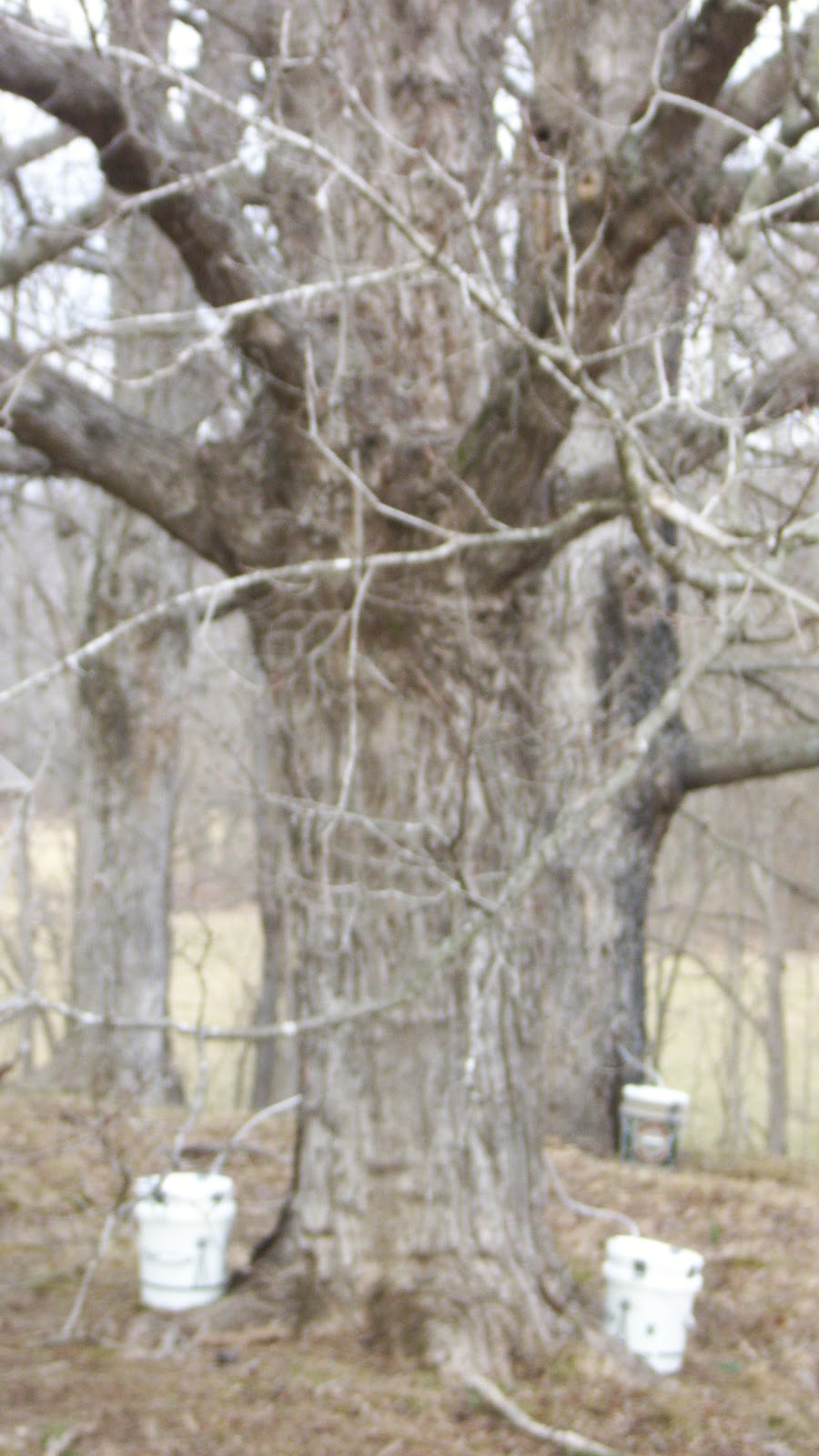
For taps, we used old metal curtain rods that had been cut to about six inches. We drilled a 5/16" hole into each tree and used a hammer to insert the metal taps.
In the first 16 hours, the trees had produced over 9 gallons of sap into the reservoirs. The next step was to build a fire, which we simmered the sap over all day, and then transferred the pots into our kitchen to finish boiling it down that evening. It went considerably faster indoors, (make sure you move your cookbooks into another room and put a fan in the window, as the condensation is thick.)
It didn't seem possible that the sap would yield syrup. It was quite clear and thin, even toward toward the end of the process. But it did!
The 9.5 gallons of sap we boiled down yielded about a quart of syrup. This is about spot on with the common estimated ratio of 40 gallons of sap to one gallon of syrup.
Maple syrup is my favorite sugar! I use it in my coffee each morning, I love it so much. The flavor of this syrup is unlike any I've tasted; smoky, caramelly, sweet. It is absolutely delicious. I wonder if this is merely due to the fact that we cooked it over a campfire, or if it also reflects how commercial products often greatly vary from homemade.
I grew up on the North Shore in Minnesota, where maple syrup production thrives and has a long history, originating with the Ojibwe tribe. As I sat by the fire, throughout the day yesterday, I felt so peaceful, and deeply connected to that history, as well as to the centurion maples in front of our house.
Wednesday, January 23, 2013
Herbal Eye Cups
Monday, December 10, 2012
Osage Orange!
A
Brief History of the Osage orange (Maclura pomifera)
“Osage-orange
is…picturesque rather than beautiful, and possess[es] strong form, texture, and
character.” -J.D. Burton
Also known
as hedge apple, bois-d’arc, horse apple, naranjo chino, among other names, the
osage orange is a rather new tree in my experience. Osage orange (Maclura
pomifera) is a member of Moraceae, the fig and mulberry family. Throughout this
past autumn, their fruit have spattered the roadways and sparked much conversation,
and they appear to be rooted firmly into North American history. I would like
to spend a few minutes sharing it.
The wood of
the osage orange said to be exceptionally resistant to decay, and has been the
preferred wood for fencing for quite some time. The trees were often planted as
living fences before barbed wire was invented in 1874 (in Illinois, by the way).
The wood also has traditionally been used to make the bow and arrow by the
Osage Indians and by other Plains tribes. Currently in Illinois, osage orange
is being planted to remediate soil near old strip mines.
I have been
perusing online discussion forums on Dave’s Garden (http://davesgarden.com/guides/pf/go/54097/) about Maclura pomifera, and
am struck by the sheer amount of people sharing fond childhood memories of the
tree, whether it is something like ‘Grandma put hedge apples in every bottom
cupboard in the house to repel spiders,’ or that the tree is the best shade
tree in Texas, or that someone’s osage orange fence posts from the 1930’s have
yet to rot…you might think the tree is Grandma’s rather eccentric yet lovable
cousin, the way these folks are talking about it.
Part of my
recent holiday in Tennessee was spent hurling osage fruits against rocks in an
attempt to split them open. While the fruit did not
break initially, it did allow us to pry it open to uncover a wild, milky
melon-like broccoli floretted fruit. The milky sap is very sticky and can cause
dermatitis in some individuals, according to Louise Riotte in Carrots Love Tomatoes. The fruit can be
made into an antibacterial soap, hand salve, or used as decoration in the home.
It was also used as a fabric dye to color khaki uniforms during the first World
War. Interestingly, though it appears to have medicinal applications, osage
orange rarely appears in the various herbals I’ve looked in.
For
more information on osage orange, check out this fabulous comprehensive article
on the web: http://www.na.fs.fed.us/pubs/silvics_manual/volume_2/maclura/pomifera.htm
I recently attempted my first salve making endeavor off a variation of this osage orange salve recipe I found on Facebook: https://www.facebook.com/photo.php?fbid=10151269383425909&set=a.10151269383180909.487906.227120805908&type=1&theater.
I used a blend of apricot kernel and almond oils, beeswax, and osage orange pulp, and it turned out pretty well! It's been working for moisturizing dry hands, and I've also applied it to a rough spot on my dog's lower back, in which it seems to be speeding the healing process.
Subscribe to:
Posts (Atom)