Tuesday, February 26, 2013

Sap Tappin': Making Maple Syrup

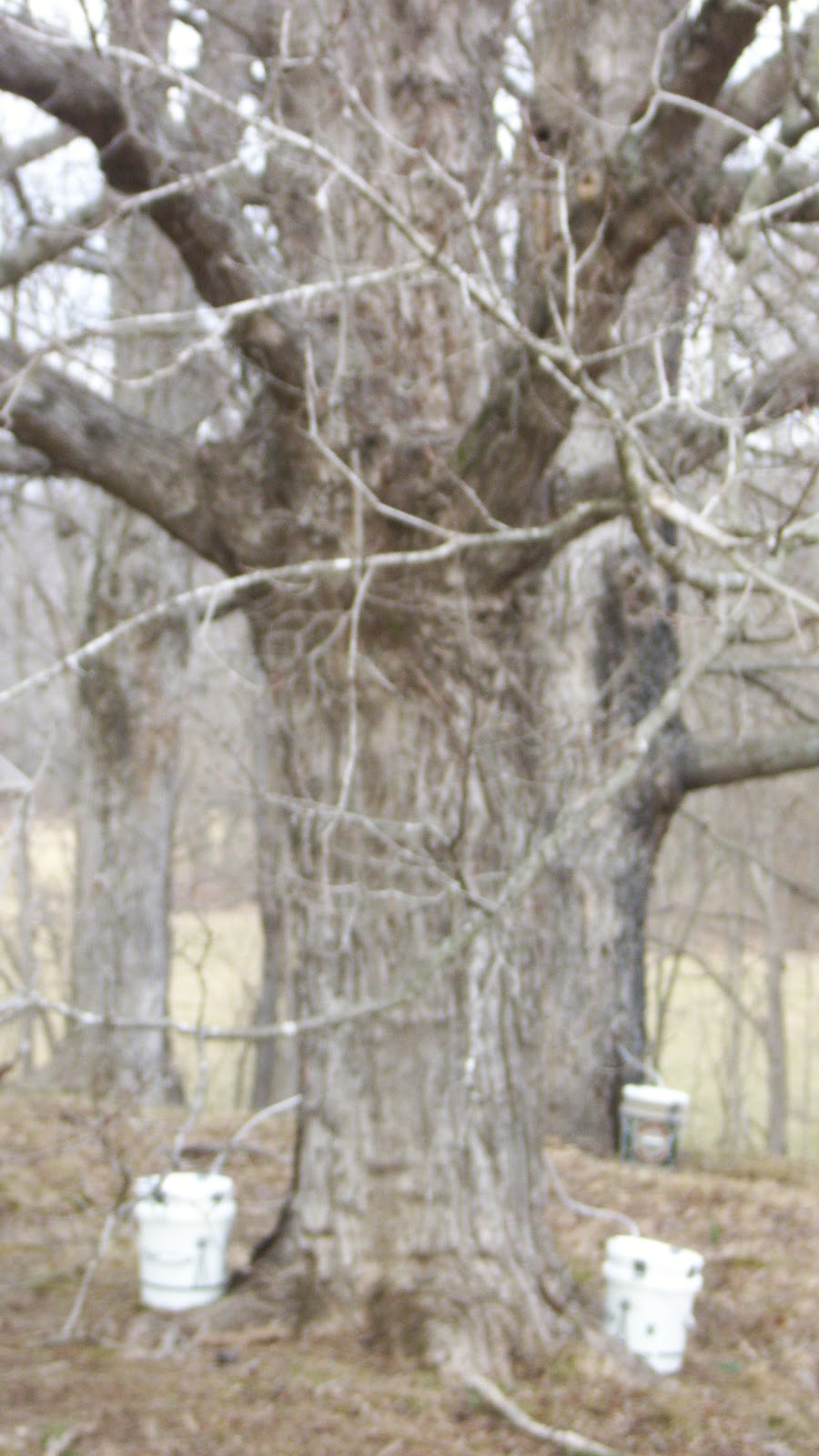
I awoke today to a bright cool morning that promised some warmth in the sunlight. After tying my flannel robe, wrapping a poncho around my shoulders, I went outside to check our sap reservoirs, several of which were overflowing with clear, sweet sap. 


For taps, we used old metal curtain rods that had been cut to about six inches. We drilled a 5/16" hole into each tree and used a hammer to insert the metal taps.


In the first 16 hours, the trees had produced over 9 gallons of sap into the reservoirs. The next step was to build a fire, which we simmered the sap over all day, and then transferred the pots into our kitchen to finish boiling it down that evening. It went considerably faster indoors, (make sure you move your cookbooks into another room and put a fan in the window, as the condensation is thick.)

It didn't seem possible that the sap would yield syrup. It was quite clear and thin, even toward toward the end of the process. But it did!


The 9.5 gallons of sap we boiled down yielded about a quart of syrup. This is about spot on with the common estimated ratio of 40 gallons of sap to one gallon of syrup.

Maple syrup is my favorite sugar! I use it in my coffee each morning, I love it so much. The flavor of this syrup is unlike any I've tasted; smoky, caramelly, sweet. It is absolutely delicious. I wonder if this is merely due to the fact that we cooked it over a campfire, or if it also reflects how commercial products often greatly vary from homemade.

I grew up on the North Shore in Minnesota, where maple syrup production thrives and has a long history, originating with the Ojibwe tribe. As I sat by the fire, throughout the day yesterday, I felt so peaceful, and deeply connected to that history, as well as to the centurion maples in front of our house.

Wednesday, January 23, 2013

Herbal Eye Cups

This is a rather informative video on herbal eye cups and washes from 7song, an herbalist from New York who does really rad stuff, often surrounding herbal first aid. The video is also quite witty :)

Monday, December 10, 2012

Osage Orange!


A Brief History of the Osage orange (Maclura pomifera)

“Osage-orange is…picturesque rather than beautiful, and possess[es] strong form, texture, and character.” -J.D. Burton

            Also known as hedge apple, bois-d’arc, horse apple, naranjo chino, among other names, the osage orange is a rather new tree in my experience. Osage orange (Maclura pomifera) is a member of Moraceae, the fig and mulberry family. Throughout this past autumn, their fruit have spattered the roadways and sparked much conversation, and they appear to be rooted firmly into North American history. I would like to spend a few minutes sharing it.

            The wood of the osage orange said to be exceptionally resistant to decay, and has been the preferred wood for fencing for quite some time. The trees were often planted as living fences before barbed wire was invented in 1874 (in Illinois, by the way). The wood also has traditionally been used to make the bow and arrow by the Osage Indians and by other Plains tribes. Currently in Illinois, osage orange is being planted to remediate soil near old strip mines.

            I have been perusing online discussion forums on Dave’s Garden (http://davesgarden.com/guides/pf/go/54097/) about Maclura pomifera, and am struck by the sheer amount of people sharing fond childhood memories of the tree, whether it is something like ‘Grandma put hedge apples in every bottom cupboard in the house to repel spiders,’ or that the tree is the best shade tree in Texas, or that someone’s osage orange fence posts from the 1930’s have yet to rot…you might think the tree is Grandma’s rather eccentric yet lovable cousin, the way these folks are talking about it.

            Part of my recent holiday in Tennessee was spent hurling osage fruits against rocks in an attempt to split them open. While the fruit did not break initially, it did allow us to pry it open to uncover a wild, milky melon-like broccoli floretted fruit. The milky sap is very sticky and can cause dermatitis in some individuals, according to Louise Riotte in Carrots Love Tomatoes. The fruit can be made into an antibacterial soap, hand salve, or used as decoration in the home. It was also used as a fabric dye to color khaki uniforms during the first World War. Interestingly, though it appears to have medicinal applications, osage orange rarely appears in the various herbals I’ve looked in.
          
  For more information on osage orange, check out this fabulous comprehensive article on the web: http://www.na.fs.fed.us/pubs/silvics_manual/volume_2/maclura/pomifera.htm

         I recently attempted my first salve making endeavor off a variation of this osage orange salve recipe I found on Facebook: https://www.facebook.com/photo.php?fbid=10151269383425909&set=a.10151269383180909.487906.227120805908&type=1&theater
I used a blend of apricot kernel and almond oils, beeswax, and osage orange pulp, and it turned out pretty well! It's been working for moisturizing dry hands, and I've also applied it to a rough spot on my dog's lower back, in which it seems to be speeding the healing process. 


Monday, November 19, 2012

simple folk tincturing


Recently, I was pawing through my tea shelf, slightly annoyed with all the clutter; realizing I had numerous herbs on the shelf that had been sitting there perhaps for over a year.

Lucky me, I happened to have a handle of vodka in my kitchen that I bought specifically for tincturing fresh artichoke leaf, which a friend gave me from her garden. With the night frosts setting in, I figure now is the perfect time to tincture everything from my garden worth salvaging, and all those dried herbs that have been stagnant on my shelf for much too long.

While there are more modern and "sophisticated" methods of tincturing (with precise ratios of dry herb to alcohol), I chose to go the folk route, which seems to have an innate, simple wisdom to it. You can find instructions on folk tincturing here http://www.youtube.com/watch?v=4dloPF1QDuw. (Brief disclaimer: I just want to point out that I do not work for Mt. Rose Herbs or attempt to promote them on this blog, I just think they do a good job of providing educational resources that are worth sharing!) Also, a quick note on vodka selection; while I usually can't afford the organic, one can often find an affordable vodka that's been filtered 4-5 times, and it will say on the label.

So above, you'll notice I made mostly medicinal tinctures (motherwort, ashwagandha, cayenne ginger, peppermint, kava kava, black walnut w/ clove, boneset, goldenseal, artichoke, oat milky seed, and a couple of infused vodkas (vanilla and coconut vanilla) for fun.

They are all made with vodka, except the cayenne ginger, which is steeped in bourbon. I'm looking forward to adding it to a hot toddy on a cold winter night.

Lastly, if you're interested in seeing what plant compounds are soluble in alcohol, or want to know basic herbal recipes for salves, syrups, infusions, etc., check this jam-packed DIY site http://earthnotes.tripod.com/basics.htm#howto.

............

So lemon balm extract is the latest industry craze (thx to Dr. Oz) that everyone wants and nobody can get (all herb suppliers appear to be out of the tincture)! I have been suggesting to people looking for it that they use the above method to make their own lemon balm extract, and voila! Easy, empowering (relaxing) solution.


Thursday, November 15, 2012

wild persimmon plethera!

This year was my first year to discover the wild persimmon, which are widespread throughout our region, and from what I hear it seems this year's trees have produced a bumper crop. They are delicious! I hear they can be made into a custard, but eating a ripe one is practically like eating sweet, smooth custard without having to do the work. Yum!

Monday, November 5, 2012

Marvelous repulsion


The eyes of an alligator are truly primordial, like thousands upon thousands of years are looking back at you; somehow this being that is alive right now, is so eerily the same as its ancestor so long ago, and steadily, in its cold blooded nature can hold your gaze in the present. 

There's something incredibly repulsive, yet simultaneously fascinating about reptiles. This first became apparent to me when I lived in Louisiana three years ago and peered into alligator eyes on a fairly frequent basis. The reptile (serpent) has prominent places throughout human mythology, as well. http://en.wikipedia.org/wiki/Snakes_in_mythology

I realized recently that I have similar inklings toward certain ancient plants, like thistles and ferns. I think it has to do with how "evolutionarily perfect" they are (think cockroaches, too...). So little has changed over millennia, and when I gaze upon them, I could be living at any point in history in that moment. 

While it is difficult to relate to these beings (many environmentalists observe that this is a major hurdle to a widespread earth stewardship); I believe this marvelous repulsion is worth acknowledging and exploring. 

E.g.


Above: Cardoon (Cynara cardunculus)
Ancestor to today's globe artichoke, perhaps cultivated for 30,000 years. 
According to a friend (whose garden this is) the cardoon is not officially supposed to be a perennial in Southern Illinois, yet it typically does overwinter. Cardoon is used in traditional cheese making in Portugal as a vegetarian rennet (http://joyofcheesemaking.blogspot.com/2010/10/homegrown-rennet.html), and the stalks are edible as well. (http://www.yougrowgirl.com/2010/11/26/growing-and-eating-cardoon/)
Yes! I want to make home-grown rennet!

....

In a pinch while cheese making last night (I spilled the last of my rennet), I used 1/2 teaspoon globe artichoke tincture to attempt to set 2 gallons milk. I left it sit overnight, and it worked! A curd formed, and while the curd was too soft to make it into the feta I had planned, it made a very tasty cottage cheese. First cottage cheese I tasted that had lipase powder in it; it's tangy, saucy and delicious!

Tuesday, October 30, 2012

Yesterday's kitchen tasks


(l-r)
sweet chili garlic sauce
roasted tomatillo salsa
pineapple quince tomato chutney
garlic herb cheese curds
cucumber olive hummus
butternut squash puree